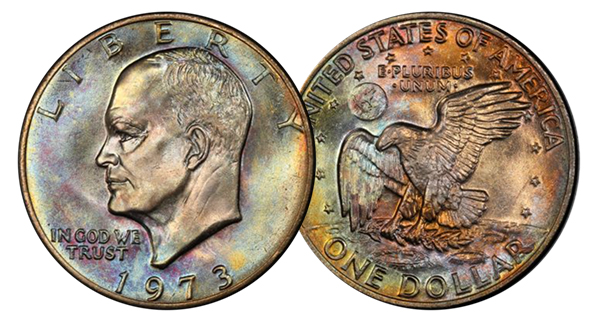
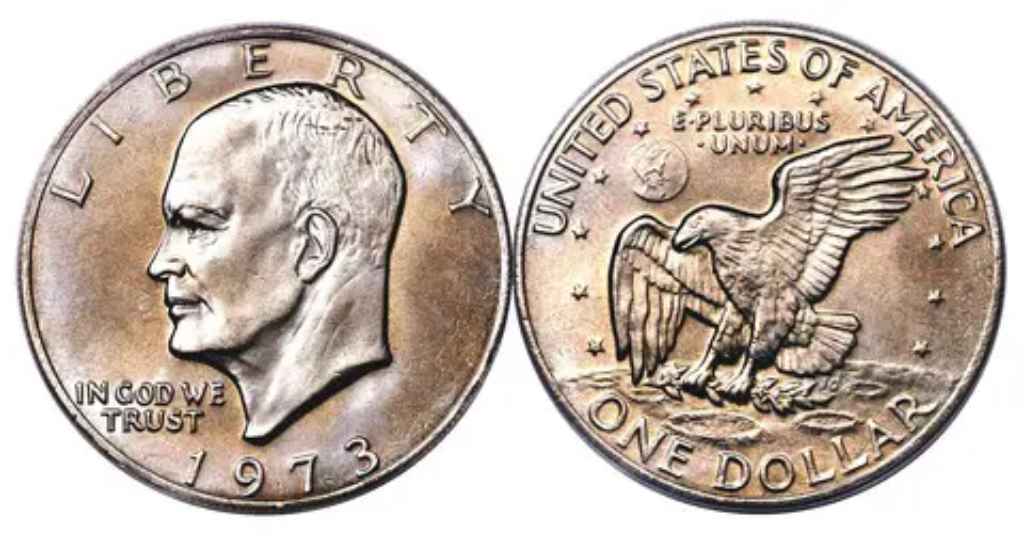
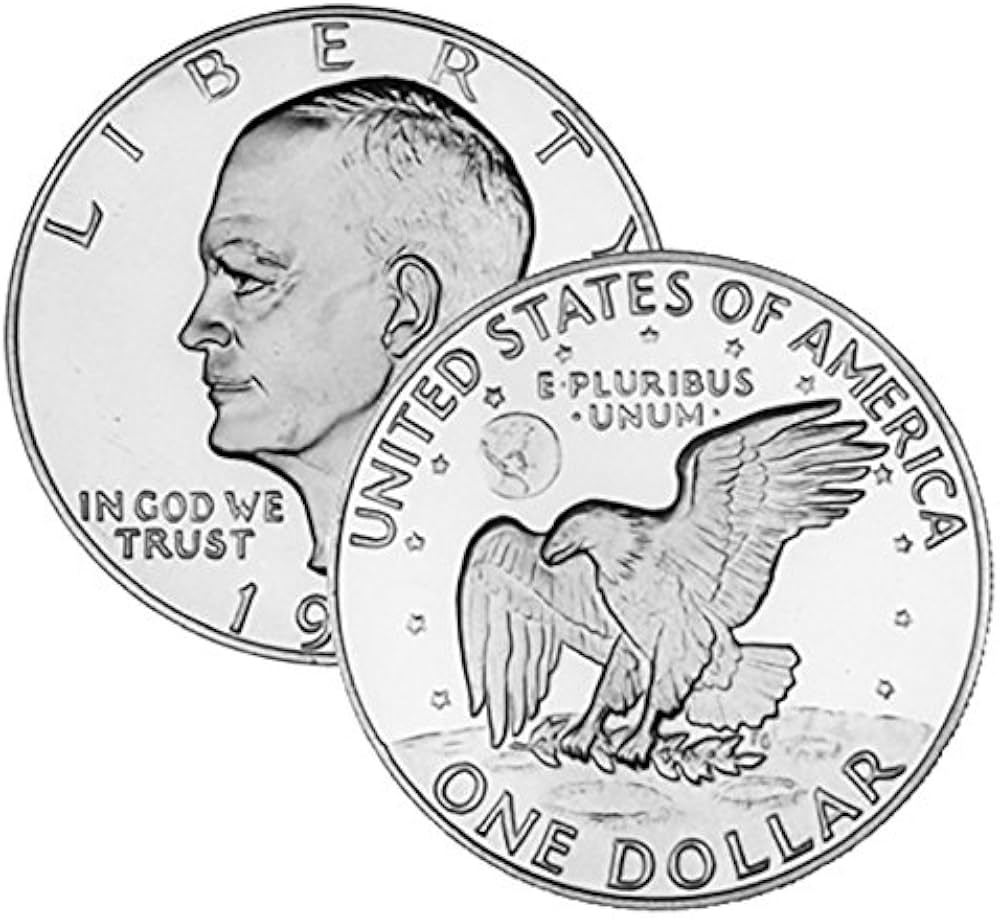
A single 1973-S Eisenhower dollar struck on the wrong planchet sold for $48,000 at Stack's Bowers. Standard 1973-S silver dollars start at their silver melt value — around $22 — but the right variety in gem condition can command hundreds or even thousands of dollars. This free guide covers every mint, every error, and the prized FS-101 DDO variety.
Select your coin's mint mark, condition, and any known errors, then click Calculate for an instant value estimate.
Step 1 — Mint MarkIf you're not yet sure of your coin's mint mark, condition, or errors, there's a 1973 Silver Dollar Coin Value Checker free tool that lets you upload a photo and get an AI-powered identification before you use the calculator above.
Describe what you see — mint mark, edge color, any doubling, weight, or packaging — and get a personalized read on your coin.
⬆️ Skipped the calculator? Get an instant estimate — it takes under 30 seconds.
Use the Free Calculator →The FS-101 doubled die obverse is the most sought-after variety on the 1973-S silver proof. Use this checker to see if your coin could be one.
Lettering on "IN GOD WE TRUST" and the date reads cleanly and crisply with no secondary impression. The area around Eisenhower's neck is smooth with no curved polishing line. Most 1973-S proofs fall into this category.
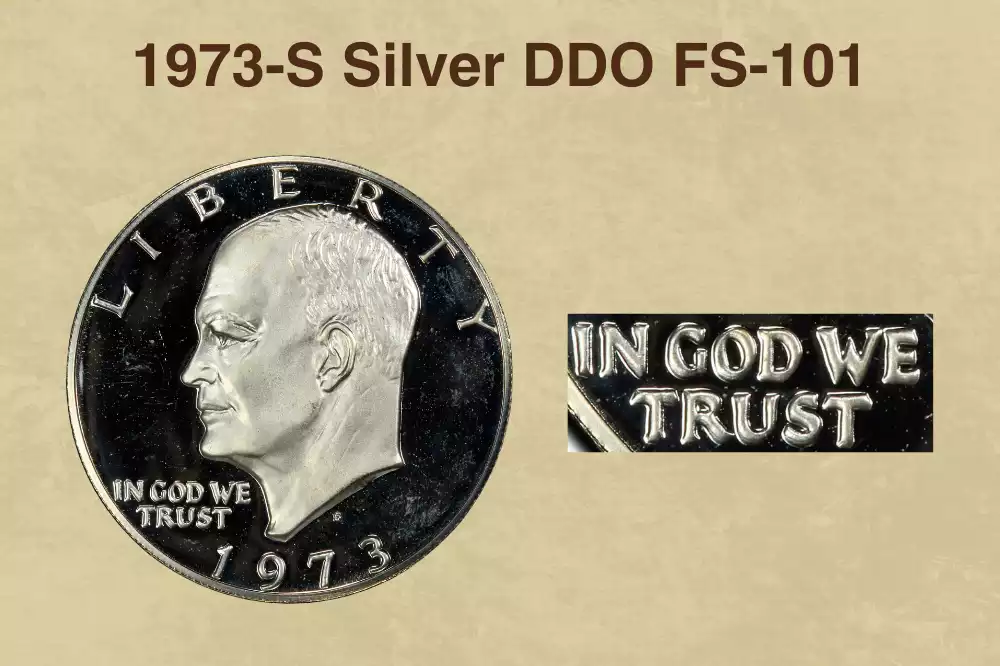
Distinct doubling is visible on "IN GOD WE TRUST" (especially on the letters "G," "O," "D") and on the date digits. Select letters in "LIBERTY" may also show a slight secondary contour. A diagnostic curved die-polishing line crossing Eisenhower's neck region confirms authenticity — this feature distinguishes genuine FS-101 coins from common hub doubling found on many 1973-S proofs.
The table below summarizes current market values across all 1973 Eisenhower dollar varieties and condition tiers. For a complete step-by-step illustrated 1973 Eisenhower dollar identification walkthrough, that guide covers every variety with photo comparisons. Values reflect recent auction data and PCGS/NGC price guides; silver-content coins carry a melt floor around $22 at current spot.
| Variety | Worn / AU | Choice (MS/PR 60–63) | Gem (MS/PR 64–65) | Superb Gem (66+) |
|---|---|---|---|---|
| 1973(P) Clad — No Mint Mark | $2–$5 | $10–$18 | $18–$35 | $100–$7,638+ |
| 1973-D Clad | $2–$5 | $10–$18 | $18–$35 | $150–$12,925+ |
| 1973-S Clad Proof | $5–$8 | $8–$15 | $15–$25 | $40–$200+ |
| 1973-S Silver Unc. (Blue Ike) | $13–$14 | $13–$17 | $17–$25 | $30–$17,500+ |
| 1973-S Silver Proof (Brown Ike) | $22–$28 | $25–$35 | $32–$55 | $55–$2,820+ |
| 1973-S Silver Proof — DDO FS-101 | — | $19–$30 | $95–$168 | $134–$2,820+ |
| 1973-S Wrong Planchet Error | $10,000–$48,000+ (2 known examples; PCGS/NGC authentication required) | |||
📱 CoinHix lets you scan your 1973 Eisenhower dollar from photos to quickly cross-check condition estimates against current market data — a coin identifier and value app.
Jump directly to any section:
The 1973 Eisenhower dollar, sold only in mint sets and collector packages, generated a small but exceptional collection of errors and die varieties. The San Francisco Mint was simultaneously running three different planchet types — clad proof, 40% silver proof, and 40% silver uncirculated — creating the perfect conditions for wrong-planchet mistakes. The four varieties below represent the most significant finds in the entire 1973 Ike dollar series, ranging from a catalogued doubled die accessible to dedicated collectors, to a unique bronze planchet error offered at $100,000.
The FS-101 is the most actively collected die variety in the 1973 Eisenhower dollar series. Catalogued in the Cherrypickers' Guide to Rare Die Varieties (5th Edition) and also designated CONECA DDO-001, it is a Class VI distended-hub doubled die that formed when the obverse die received two slightly misaligned hub impressions during manufacturing. Every coin struck from that die carries the same doubled design elements, making this a true die variety rather than a mechanical error.
Identification centers on the obverse lettering. Under a 10× loupe, examine "IN GOD WE TRUST" — particularly the letters G, O, and D — where a secondary contour or shelf is clearly visible. The date digits "1973" also show measurable doubling, and select letters in "LIBERTY" carry a lighter secondary impression. The clinching diagnostic: a curved die-polishing line running across Eisenhower's neck area on the obverse. This line is present on all confirmed FS-101 specimens and distinguishes the variety from the widespread, lower-value hub doubling found on many 1973-S silver proofs.
Collector demand is strong because the variety is scarce but findable — dedicated cherry-picking through proof sets still turns up examples. In the most actively traded grade of PR69 DCAM, certified examples have realized $134 to $731. The top grade of PR70 DCAM commands a substantial premium, with sales ranging from $1,076 to $2,820, compared to a standard PR70 DCAM Brown Ike trading near $300–$500. Authentication by PCGS or NGC and the explicit FS-101 designation on the holder are essential for commanding variety premiums.
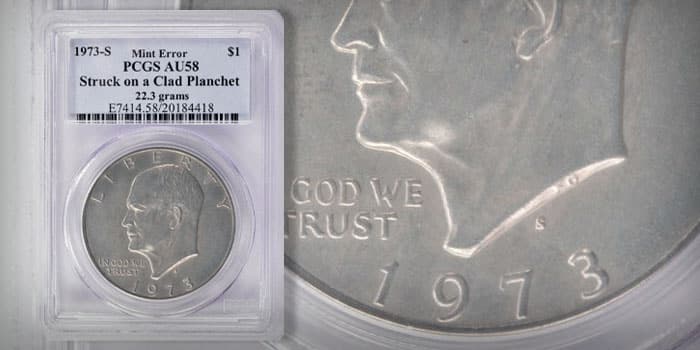
This is arguably the most dramatic and valuable error in the entire Eisenhower dollar series. The 1973-S silver uncirculated "Blue Ike" was supposed to be struck on a 40% silver planchet weighing 24.59 grams. Instead, a small number of copper-nickel clad planchets — the same type used for circulation strikes — were accidentally mixed into a shipment of silver planchets at San Francisco and struck as part of the Blue Ike production run. Only two confirmed examples have been certified, making this one of the rarest modern U.S. coin errors.
Identification requires three checks used together. First, weigh the coin precisely: a genuine Silver Blue Ike weighs 24.59–24.60 grams, while the wrong-planchet error weighs approximately 22.68 grams — the weight of a standard clad planchet. Second, examine the edge: the silver issue shows a uniform silver-gray color throughout, while this error displays the telltale orange-red copper core of a clad coin. Third, the coin possesses the satiny uncirculated luster of a Blue Ike — not a mirrored proof finish — showing it escaped quality control during the uncirculated packaging run.
The discovery coin, found in original Blue Ike government packaging by collector John Wrublewski, was graded MS67 by NGC and sold for $48,000 at a Stack's Bowers ANA Auction in August 2021. A second example, graded AU-58 by NGC, was obtained at face value from a California bank. Error specialist Mike Byers has described these coins as "one of the rarest and most significant Eisenhower dollar errors known." Any suspected example must be authenticated by PCGS, NGC, or ANACS before any transaction.
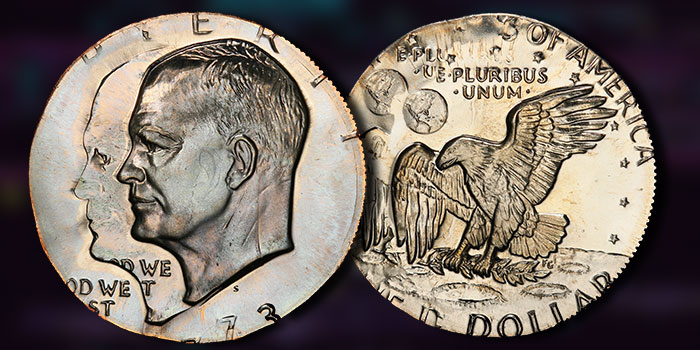
This extraordinary combination error involves a 1973-S clad proof dollar that was struck twice on a copper-nickel clad planchet intended for a Kennedy half dollar. Because the half dollar planchet (diameter ~30.6mm) is significantly smaller than the Eisenhower dollar planchet (38.5mm), the design was compressed and partially off the flan. The double-strike added further dramatic misalignment, creating what appears to be two overlapping side profiles of President Eisenhower — an unintentional "jugate" portrait that is visually spectacular.
On the obverse, the double-strike produces two offset Eisenhower busts with overlapping inscriptions. The reverse similarly shows dual moon imagery and partial eagle designs. Because the undersized planchet could not accommodate the full design, the outer portions of both die faces are missing on the struck coin. NGC certified the finest known example as PF-66 Cameo — the combination of proof dies, a clad half dollar planchet, and the double-strike makes this one of the most complex modern coin errors documented.
A single example sold at Heritage Auctions' Platinum Night session on August 4, 2020, for $19,200. The coin was NGC-graded PF-66 Cameo, and that result confirmed what error specialists had long suspected: visually dramatic combination errors on proof Eisenhower dollars command five-figure premiums even at relatively accessible circulated-proof grade levels. Only about four to six such double-strike/wrong-planchet combination errors are believed to exist across the entire Eisenhower dollar series from all years.
Off-center strikes occur when the planchet fails to seat correctly between the dies before the press fires, leaving a blank crescent of unstruck metal alongside a partial design. On a large 38.5mm Eisenhower dollar, the visual drama of misalignment is immediately obvious — even a 10% off-center strike is noticeable on this canvas. These errors escaped quality control when mint inspectors missed misaligned coins during the Mint Set packaging process for 1973(P) and 1973-D issues.
Value and desirability are driven by two factors: the percentage of off-center displacement and whether the full date remains visible. Minor off-center strikes in the 5–15% range typically sell for $50–$150. More dramatic examples showing 40–60% displacement command significantly stronger premiums. Date visibility is critical — a coin where "1973" is fully readable despite dramatic displacement is worth substantially more than one where the date has shifted off the planchet. Collectors prize pieces with 40–50% displacement and a complete, clearly legible date.
The 38.5mm diameter of the Eisenhower dollar makes even modest off-center strikes visually compelling compared to the same percentage of displacement on smaller denominations. Strong examples in the $600–$800+ range typically combine at least 40% displacement with full date visibility and solid eye appeal. Because 1973(P) and 1973-D dollars were sold only in Mint Sets, off-center examples are genuinely scarce — not the product of circulating coinage where errors surface more frequently. Any PCGS or NGC authentication adds buyer confidence and liquidity for examples above $200.
🔍 Found one of these errors on your coin? Get an instant value estimate right now.
Run the Calculator →
1973 was a pivotal year for the Eisenhower dollar. The Mint drastically cut production from the high-volume years of 1971–1972, restricting both the Philadelphia and Denver clad issues to just 2 million coins each — sold exclusively in Mint Sets, none released for general circulation. The San Francisco Mint continued its silver collector programs. Note that the mintage figures below represent official production; survival in Mint State is high for all issues because none circulated, though gem examples above MS65 are genuinely scarce for the clad coins.
| Issue | Mint | Composition | Mintage | Distribution Method |
|---|---|---|---|---|
| 1973(P) Clad | Philadelphia | 75% Cu / 25% Ni over Cu core | 2,000,056 | Mint Sets only |
| 1973-D Clad | Denver | 75% Cu / 25% Ni over Cu core | 2,000,000 | Mint Sets only |
| 1973-S Silver Unc. (Blue Ike) | San Francisco | 80% Ag / 20% Cu outer; 79% Cu / 21% Ag core (40% Ag overall) | 1,883,140 | Blue Ike 3-coin sets ($9) |
| 1973-S Silver Proof (Brown Ike) | San Francisco | 80% Ag / 20% Cu outer; 79% Cu / 21% Ag core (40% Ag overall) | 1,013,646 | Brown Ike 3-coin sets ($10) |
| 1973-S Clad Proof | San Francisco | 75% Cu / 25% Ni over Cu core | 2,760,339 | Standard 6-coin Proof Set |
| Total All 1973 Issues | ~9,657,181 | All collector distribution | ||
Because no 1973 Eisenhower dollars were issued for circulation, you'll rarely encounter a genuinely worn example. The real grading challenge is separating Choice Uncirculated from Gem — and then finding those elusive MS66+ or PR70 DCAM coins that command serious premiums.
High points — Eisenhower's cheek, the eagle's breast — show flat wear with no luster. Because 1973 Ikes were Mint Set coins, genuine worn examples are extremely uncommon. If you have one, it almost certainly passed through commerce informally after being taken from its Mint Set packaging. Value for clad coins is essentially face value.
Full luster is present but the coin shows multiple contact marks — small nicks, bag marks, or haze from Mint Set packaging. Eisenhower's cheek and the eagle's breast (opposite the portrait) are the most vulnerable areas. Most raw 1973 Mint Set coins fall into this range when removed from their holders. Value for clad: roughly $10–$18.
Only minor contact marks remain, and luster flows fully across the coin's surface. Eye appeal is good to strong. In MS65, the 1973(P) and 1973-D clad coins are scarce — PCGS estimates fewer than 2,500 examples survive in MS65 or higher for the Philadelphia issue. Silver 1973-S Blue Ike coins reach MS65 with relative ease due to their careful packaging. Clad gem values: $18–$35.
Near-flawless surfaces with exceptional eye appeal. Fewer than 250 examples of the 1973(P) are believed to exist at MS66 or above. For proof Brown Ike coins, Deep Cameo (DCAM) contrast — stark white frosted devices against mirror fields — is the key premium driver. A PR70 DCAM Brown Ike is the holy grail; examples with the FS-101 designation have sold in the high four figures.
🔎 CoinHix helps you match your coin's surface details to graded examples for a quick condition estimate before visiting a dealer — a coin identifier and value app.
Your best venue depends on what you have: a common silver Ike near melt value, a gem clad example, or a major error. The four channels below cover the full spectrum.
For gem examples (MS65+), the FS-101 DDO in high grades, or major error coins, Heritage reaches the deepest pool of Eisenhower dollar specialists and advanced registryset builders. Their Platinum Night and Signature sessions regularly feature top-pop Ike dollars. Expect a buyer's premium on the sale price; Heritage earns their fee by maximizing competition. Submit through their online consignment process and ask about lot estimates before committing.
The widest buyer pool for common to mid-grade 1973-S silver Ike coins ($13–$100 range). Use completed-listing search to verify realistic prices — see recent sold prices and completed listings for 1973 Eisenhower dollars to set your opening bid correctly. PCGS or NGC holders help your listing stand out and typically achieve 20–40% premiums over raw coins. Use "Buy It Now" for quick liquidity, auctions for potentially higher prices on desirable examples.
For common 1973-S silver pieces near melt value, a local dealer offers instant cash with no selling fees or shipping risk. Expect to receive 70–85% of melt value for standard examples. For any coin you believe might be a variety or error (especially the FS-101 DDO), have it attributed and authenticated first — dealers may not recognize the variety designation and will offer you a generic silver melt price. Bring your research notes and the PCGS CoinFacts page to the counter.
The r/Coins4Sale and r/CoinSwap communities offer zero seller fees and direct access to knowledgeable collectors who understand variety designations like FS-101. Best for coins in the $25–$200 range where auction house minimums make consignment impractical. Post clear macro photos showing the obverse, reverse, and edge. Include weight and any PCGS/NGC holder details. Build feedback through small sales first before listing higher-value pieces.
No. The 1973(P) Philadelphia and 1973-D Denver coins are copper-nickel clad and contain no silver at all. Only the 1973-S coins struck at San Francisco in the special "Blue Ike" uncirculated and "Brown Ike" proof packages contain 40% silver. If your coin lacks an "S" mint mark, it is clad and worth roughly face value to a few dollars in uncirculated condition.
In MS63 condition, the 1973-S silver (Blue Ike) is worth around $13–$17. In gem MS65 it rises to roughly $20–$25. A proof (Brown Ike) in PR68 is worth around $25–$40. Top examples in MS69 have sold for $17,500 at auction. The silver melt value alone is approximately $22 at current spot prices, providing a floor on all 1973-S silver pieces.
The FS-101 (Fivaz-Stanton designation) is a confirmed Class VI distended-hub doubled die obverse variety found on the 1973-S silver proof. Doubling is visible on "IN GOD WE TRUST," the date, and select letters in "LIBERTY." A diagnostic curved die-polishing line crosses Eisenhower's neck. In PR69 DCAM, the variety commands $134–$731. In PR70 DCAM, examples have sold between $1,076 and $2,820 — far above a standard Brown Ike.
Check three things: (1) the mint mark must be an "S" above the date; (2) the coin's edge should show a consistent silver-gray color with no orange copper core strip visible — clad coins show a distinct reddish-copper band; (3) weigh the coin — silver "Ike" pieces weigh 24.59–24.60 grams, while clad versions weigh 22.68–22.70 grams. All three checks together give a reliable answer before you seek professional authentication.
The rarest documented 1973 error is the 1973-S silver on a bronze planchet (broadstruck), with only one known example certified by PCGS at PR-62 Red Cameo. It has been offered at $100,000. The second rarest is the 1973-S uncirculated struck on a copper-nickel clad planchet, with only two confirmed examples — the discovery coin sold for $48,000 at Stack's Bowers in August 2021.
The 1973(P) and 1973-D were sold exclusively in official U.S. Mint sets — none were released for general circulation. The 1973-S issues were sold in special "Blue Ike" uncirculated packs and standard proof sets. Because no 1973 Eisenhower dollars were issued for circulation, most surviving examples are in Mint State condition, though the mint set packaging could introduce minor bag marks and haze.
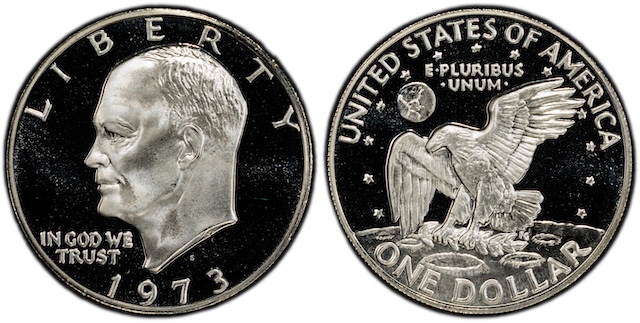
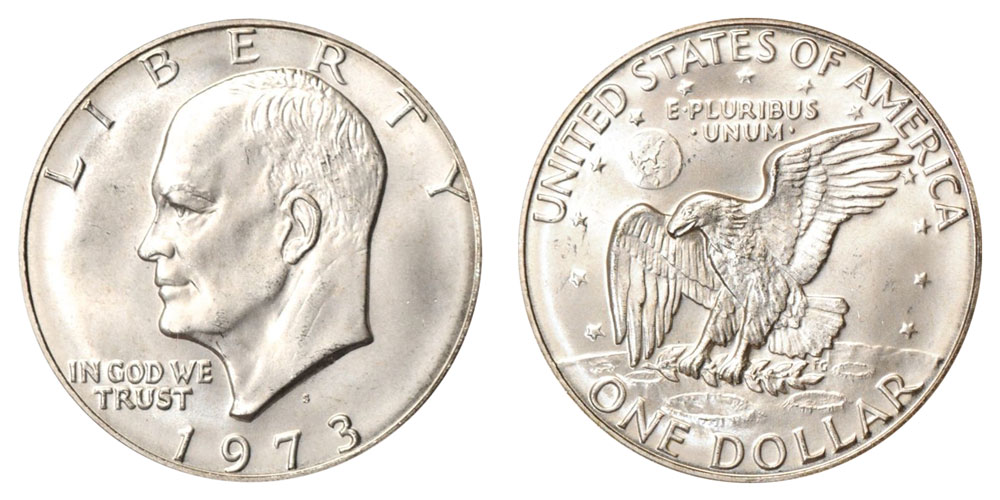
The standard reverse shows a bald eagle landing on the Moon with an olive branch in its talons, designed by Michael Collins and James Cooper after the Apollo 11 mission patch. The Earth appears in the upper left field. The inscription reads "UNITED STATES OF AMERICA" along the top, "ONE DOLLAR" at the bottom, and "E PLURIBUS UNUM" in the lower field. The 1973 reverse uses the Type 2 modified hub with improved detail.
The San Francisco Mint struck 1,883,140 silver uncirculated ("Blue Ike") examples and 1,013,646 silver proof ("Brown Ike") examples in 1973, for a combined 40% silver total of about 2,896,786. The Philadelphia Mint made 2,000,056 clad examples and Denver made 2,000,000 clad examples — both sold only in mint sets. Total 1973 production across all issues was approximately 7,656,395 coins.
Standard 1973-S silver examples have a built-in floor at melt value (roughly $22 in silver). For investment upside, focus on gem MS67+ or PR70 DCAM examples and the FS-101 DDO variety in high grades. The wrong-planchet error coins — if you could locate one — have delivered dramatic auction premiums. For most collectors, PCGS or NGC-certified gem examples in population-low grades offer the best long-term potential.
For common examples worth $15–$50, eBay reaches the widest buyer pool, though fees reduce your net. A local coin dealer offers instant payment but below retail. For gem MS66+, DDO FS-101 examples, or major errors, Heritage Auctions or Stack's Bowers will maximize realized prices through their national collector audience. Always get rare or error coins authenticated by PCGS or NGC before selling — certification dramatically increases buyer confidence and sale price.
Use the free calculator — takes under 30 seconds. No signup, no email required.
Run the Free Calculator →